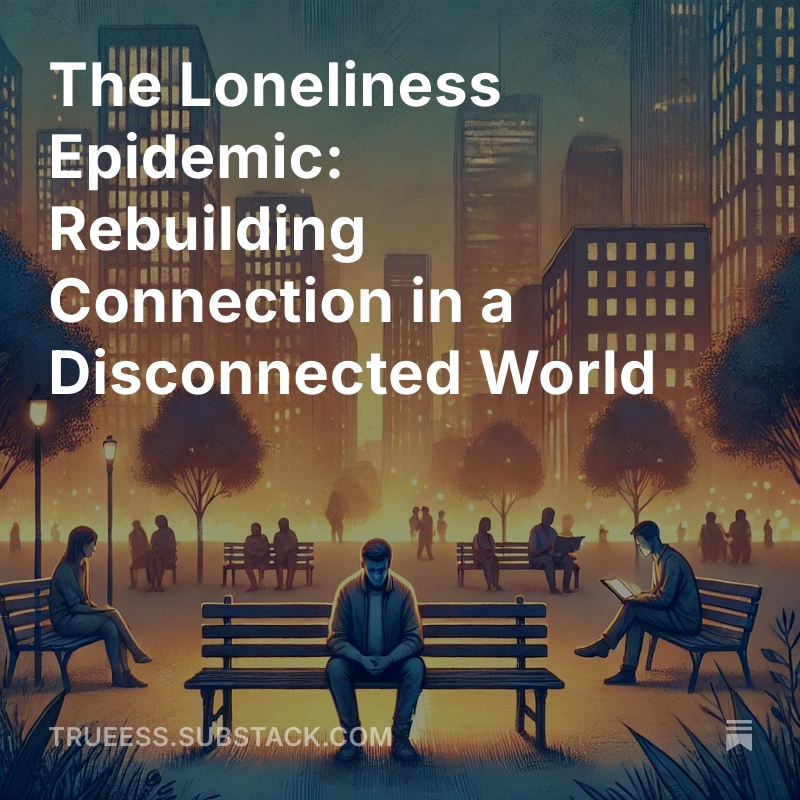
True Insights- The Growing Crisis of Loneliness
I’ve been thinking a lot about the U.S. Surgeon General’s 2021 warning about the crisis of loneliness and depression. The report reveals that approximately half of U.S. adults experience measurable levels of loneliness, with young adults facing some of the highest rates. This pervasive issue not only affects mental health but also increases the risk of heart disease, stroke, and dementia. (hhs.gov)
That report emerged during the height of COVID lockdowns, making sense of the sudden rise in isolation. But as someone who has worked in mental health for years, I knew this issue existed long before the pandemic—and it continues today.
We live in a time where community ties are unraveling. Isolationist thinking, loss of shared spaces, and a growing distrust of others have all contributed to this epidemic. We’re more connected than ever digitally, yet so many feel deeply alone.
Why Is It So Hard to Make Friends as an Adult?
It’s no secret that making friends in adulthood is difficult. Many people rely on proximity-based friendships—the ones formed naturally through school, work, or shared activities. But as life changes, these friendships often fade unless we intentionally nurture them.
In childhood, friendships develop through frequent, unstructured time together. As adults, responsibilities increase, schedules tighten, and friendships require effort and intentionality to sustain.
■ The Shift From Proximity Friend to Personal Friend
Moving beyond a friendship of convenience to a deeper, lasting connection can feel uncertain. Here’s how to strengthen those bonds:
- Take Initiative – Don’t wait for the other person to make plans. If you enjoy their company, reach out!
- Extend Invitations Beyond the Shared Space – If you only talk at work, school, or a specific group, invite them to something casual outside of it (grabbing coffee, a walk, or an event).
- Share More About Yourself – Opening up about your interests, challenges, and experiences builds trust and deepens connection.
- Support Their Interests – Show up for their art show, book launch, or game night. Engagement strengthens friendships.
- Check In – A quick text or message asking how they’re doing keeps the connection alive.
Friendship requires consistency. If we want deeper relationships, we have to put in small, steady efforts.
Why Are We So Disconnected?
■ The Decline of Community
We’ve lost the village mentality. Many cultures worldwide still embrace collective care, where neighbors check in on each other and no one goes hungry. My mother’s Caribbean village was like this—if you needed a meal, you could stop by any home, and they would share what they had. There was a sense of dependability. In many places today, that kind of interconnectedness is fading.
■ Social Media: A Support, Not a Substitute
Social media can offer a sense of connection, but it’s not a replacement for real-life relationships. Younger generations, in particular, are experiencing a loss of social skills and a skewed perception of reality, making it harder to build in-person connections. People often feel more comfortable online because it removes the fear of being perceived or judged. While that can be helpful, it can also make us complacent in avoiding physical togetherness altogether.
■ Fear and Mistrust
An “everyone-for-themselves” mentality is driving deeper isolation. When we assume the worst in others, we become wary, defensive, and withdrawn. This fuels a cycle—mistrust leads to avoidance, which reinforces loneliness, which then increases negative thinking patterns and decreases empathy for others.
■ Lack of Support for Parents & Families
Raising children or managing a household without a support system is overwhelming. Many parents feel like they are doing everything alone because they are. The absence of communal care makes family life even more challenging.
Despite all this, the fact that loneliness is a growing crisis means that people want connection. The need is there—we just have to rebuild it.
So How Do We Reconnect?
The good news? Change is already happening. People are organizing, forming local groups, and reclaiming communal spaces. Libraries, bookstores, local bars, and cafés are becoming third spaces again—places where people can simply exist and engage.
I get it. We all have busy schedules and life can often feel unmanageable. Modern adulthood comes with an overwhelming amount of “life admin”—the never-ending cycle of paperwork, appointments, bills, and responsibilities. NPR describes this stress as “the admin of your own life,” a burden that makes finding time for connection even more difficult. Between work, family, and the stress of managing the “admin” (NPR, 2019), socializing can feel like just another exhausting task.
But connection doesn’t have to be time-consuming or draining. Setting intentional times to connect is important—even once a month can make a difference. The key is to find a space where you feel comfortable and ease into it.
Here are some ways to start reconnecting:
1. Find Low-Cost or Free Community Activities
Money is tight for many, but connection doesn’t have to be expensive. Look for:
- Local library events (many host clubs, workshops, and social gatherings)
- Silent book clubs (a low-pressure way to meet others—just bring a book and read together)
- Hobby groups (crafting, nature walks, cooking, sports, etc.)
- Facebook Groups or Reddit threads for activities in your town
If nothing exists in your area, that might be a sign there’s a real need—maybe you’re the one who can start something.
■ A Model I Love: Silent Book Club
A great example of a low-pressure way to engage socially is the Silent Book Club in my town. It’s a once-a-month, no-pressure gathering. You bring your own book, sit in a space with others, and read silently. There’s optional time for mingling, but no obligation. It’s a great way to be around people without the anxiety of forced conversation.
2. Build Comfort in Small Steps
It’s normal to feel nervous or self-conscious in a new space. Everyone is not looking at you or judging you. Most people are in their own heads, just like you, thinking about how they appear in a social space.
Putting yourself out there can feel intimidating, but it gets easier. If social settings feel overwhelming, ease into them. Start with small, achievable goals:
- Set a time limit – Stay for at least 20 minutes. If you’re uncomfortable, you can leave.
- Try twice – If the first time feels off, go again before deciding it’s not for you.
- Be open to small talk – Everyone is a little nervous. Simple icebreakers like commenting on the event, the weather, or complimenting someone’s outfit can open doors to conversation.
- Give yourself an exit strategy – Set an alarm (on vibrate) if you need an out.
3. Shift Your Mindset on Community
The fastest path to friendship is through shared interests. The idea that we should do everything alone isn’t sustainable. We aren’t just responsible for ourselves—we are responsible for each other.
If we start small, we build trust, connection, and tolerance, which leads to deeper bonds and more meaningful relationships.
Final Thoughts
We are a social species. Community isn’t just a luxury—it’s necessary for our mental, emotional, and physical health. If you’re feeling lonely, you are far from alone. The desire for connection is universal.
That said, maintaining healthy boundaries is just as important as seeking connection. Not every space is safe or welcoming. If people are mean-spirited, unkind, or dismissive, that is not your tribe. Connection should not come at the cost of your peace.
Also, don’t overfill your plate. You don’t have to be everywhere or attend every event. Prioritize quality over quantity—a few meaningful relationships will always outweigh shallow, surface-level interactions.
If you find something that works for you, share it—someone else might be searching for the same thing.
Let’s start rebuilding together.
Got a question weighing on your mind about life, relationships, boundaries, mental wellness, or navigating the chaos of the world? Ask True!
📩 Submit your questions anonymously via:
📧 Email: AskTruees@gmail.com
Leave a Reply